
A RAG chatbot is an AI assistant that searches your own documents first, then writes its answer using what it found. RAG stands for retrieval-augmented generation: "retrieval" means finding the right passages, and "generation" means the AI writing a reply from them. The result is a chatbot that answers from your policies, manuals and help pages instead of relying only on what the AI model learned during training.
At a glance: RAG helps a chatbot give answers that match your business and point to where each answer came from. It reduces made-up answers but does not remove them, so it still needs testing. It works best on clear, current, text-based documents and struggles with poor scans, complex tables and out-of-date files.
RAG in one sentence, and where it came from
AWS describes RAG as making a large language model (LLM), the type of AI behind tools like ChatGPT, check an authoritative knowledge base outside its training data before it responds. In plain terms: look it up first, then answer.
The idea was set out in a 2020 research paper by Patrick Lewis and colleagues, "Retrieval-Augmented Generation for Knowledge-Intensive NLP Tasks". The authors noted that language models store facts inside themselves but struggle to access and update that knowledge precisely. Adding a separate, searchable store of documents was their answer.
If your customers write in Arabic, the chatbot also has to understand how they actually write: see this guide to Arabic AI chatbots and dialects.
How a RAG chatbot works, step by step
- Collect the documents. You choose the files the chatbot may use: FAQs, product guides, policies, contracts or knowledge base articles.
- Split them into chunks. Each document is cut into short passages, often a few paragraphs long, so the system can find the exact part that matters.
- Index them. The chunks are stored in a searchable index. Many systems use a "vector store", which records the meaning of each passage so it can be found even when the question uses different words. OpenAI's file search tool, for example, combines this meaning-based (semantic) search with ordinary keyword search.
- Search when a question arrives. The system looks up the passages most relevant to the question. Microsoft notes that sending a model everything wastes effort and lowers quality, so good retrieval returns only the most useful chunks.
- Answer from the passages. The chosen passages are given to the model with an instruction to answer from them, and ideally to say which document each point came from.
Nothing here retrains the AI model. When a policy changes, you update the document and the index, and the chatbot's answers can change with it.
Why it reduces made-up answers (but doesn't stop them)
AI models sometimes produce confident answers that are wrong, often called "hallucinations". Google Cloud explains that giving the model relevant facts as part of its input can mitigate this, and that the key is making sure the most relevant facts are found and the answer is grounded in them.
That "if" matters. A RAG chatbot can still go wrong when:
- the search finds the wrong passage, or misses the right one;
- the documents themselves are wrong, vague or contradict each other;
- the question needs information that is not in any document, and the model fills the gap by guessing.
So treat RAG as a way to reduce errors, not a guarantee. Build a set of real test questions with known correct answers, check the chatbot against them before launch, and tell it to say "I don't know" and hand over to a person when the documents don't cover a question.
Which documents work well, and which cause trouble
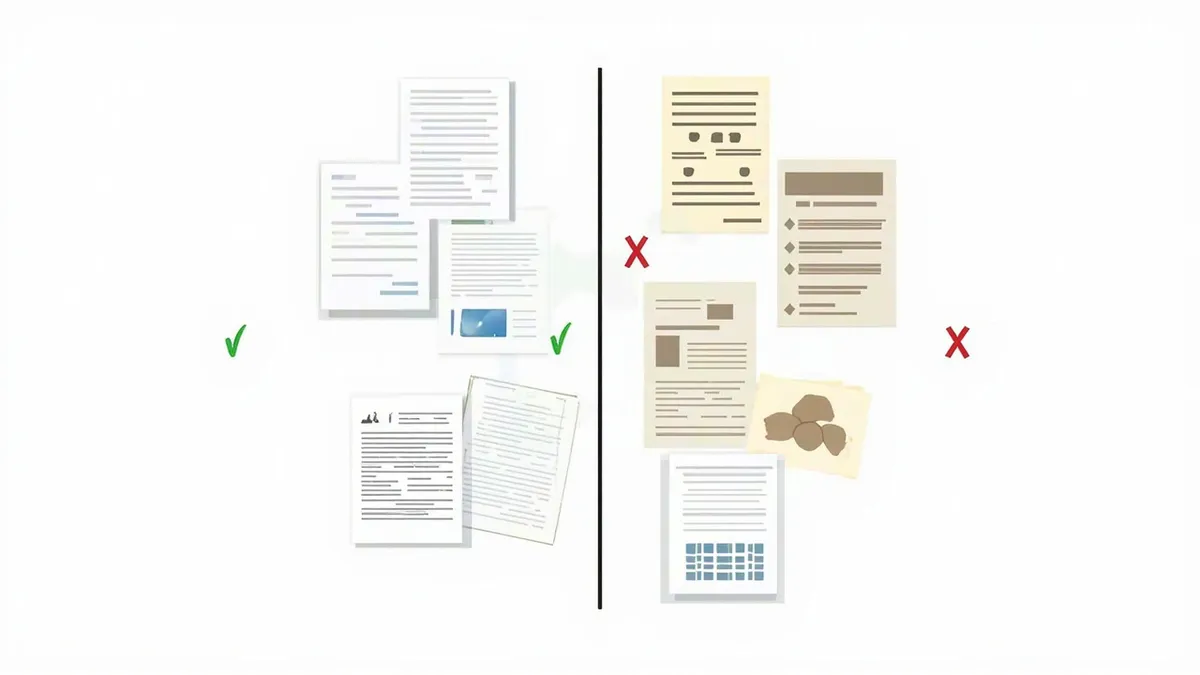
| Works well | Causes trouble |
|---|---|
| Clear written FAQs and help articles | Scanned PDFs and photos of paper, unless the text is extracted reliably first |
| Policies with headings and one topic per section | Large or complex tables, where splitting can separate numbers from their labels |
| Product manuals and procedures | Old versions of policies left alongside the new ones |
| One agreed, current version of each document | Notes, email threads and drafts with no clear owner |
The biggest risk is usually not the technology but the content. If last year's refund policy sits next to this year's, the chatbot may quote either one. Decide who owns each document and remove out-of-date versions before you start.
How answers can cite their sources
Because the chatbot answers from specific passages, it can show which documents it used. AWS points out that the output can include citations, so users can check the source themselves. This is one of the most practical benefits of RAG: staff and customers can click through to the policy rather than trusting the reply blindly.
Ask for citations that name the document and, where possible, the section. Then spot-check them during testing. A citation only helps if it points to the passage that actually supports the answer.
Permissions and data protection
A RAG chatbot is only as private as its index. Microsoft gives a clear example: finance data should only be available to the finance team, even when a senior executive asks the chatbot. Users should only retrieve content they are authorised to see, so plan permissions before you load documents.
If the documents contain personal data, UK GDPR applies. The ICO's guidance on AI and data protection covers accountability, accuracy, security and data minimisation, which means using only the personal data you actually need. The ICO notes this guidance is under review following the Data (Use and Access) Act, so check the latest version. This is general information, not legal advice.
When RAG is the wrong tool
- Live figures. Stock levels, order status or account balances belong in a direct connection to the system that holds them, not in a document index.
- Calculations and decisions. Quotes, eligibility checks and pricing rules are better handled by normal software logic.
- A handful of fixed questions. If people ask the same ten things, a simple FAQ page or a scripted chatbot may be cheaper and more predictable.
- Messy or missing documents. If the answers aren't written down clearly anywhere, fix the documents first.
Off-the-shelf tools with a document upload feature are a sensible first test for small, low-risk cases. A custom build makes sense when you need permissions, integrations with your systems or tested accuracy.
How Rinaztec can help
We build custom AI agents that answer questions from your own help docs and policies, with retrieval over your documents, source citations and evaluation tests to measure accuracy before launch. They hand off to your team with the full context when a person is needed. See our AI agent development service: projects start from $6,000 and typically go live in 3 to 5 weeks.
Want a chatbot that answers from your own documents? Book a free 30-minute call and we will help you decide whether RAG is the right fit.