
UAE e-invoicing becomes mandatory in phases from 1 January 2027. Businesses with revenue of AED 50 million or more go first and must appoint an Accredited Service Provider by 30 October 2026. Smaller businesses must appoint one by 31 March 2027 and go live on 1 July 2027. B2B and B2G invoices are in scope, and a PDF emailed to a customer will no longer count as an e-invoice.
This guide explains what the mandate means in plain words, the dates and fines, and the part most guides skip: what it means for the invoicing, ERP or CRM system your business already runs.
At a glance: find your phase, appoint an Accredited Service Provider (ASP) from the Ministry of Finance's approved list before your deadline, then make sure your own system can send clean, structured invoice data to that provider. The last step is where most of the work sits.
What UAE e-invoicing actually is
An e-invoice is not a PDF. The Ministry of Finance is clear that PDFs, Word files, scans, images and emails are not e-invoices. An e-invoice is structured data: every field (seller, buyer, tax registration numbers, items, VAT) is sent in a standard machine-readable format so the buyer's system can read it automatically and the Federal Tax Authority (FTA) receives the data electronically.

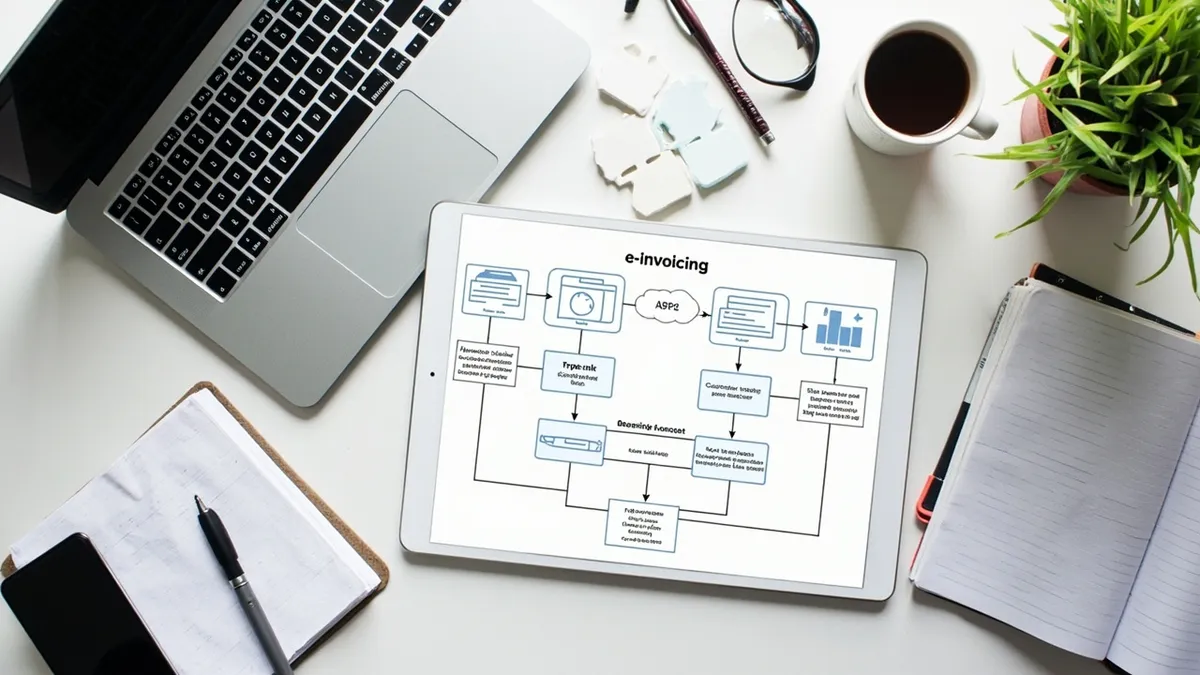
The UAE uses a model built on Peppol, an international network for exchanging e-invoices. You do not connect to the FTA directly. Instead, each business appoints an Accredited Service Provider: a company approved by the Ministry of Finance that validates your invoices, sends them to your customer's provider and reports the data to the FTA.
The legal basis is Ministerial Decisions No. 243 and 244 of 2025, amended by Ministerial Resolution No. 66 of 2026, with penalties set by Cabinet Decision No. 106 of 2025.
The deadlines
| Who | Appoint an ASP by | E-invoicing mandatory from |
|---|---|---|
| Any business, voluntarily | Any time | Optional from 1 July 2026 |
| Revenue of AED 50 million or more | 30 October 2026 | 1 January 2027 |
| Revenue under AED 50 million | 31 March 2027 | 1 July 2027 |
| Government entities | 31 March 2027 | 1 October 2027 |
"Revenue" here means gross income in your most recent accounting period, based on your financial statements. If you are close to AED 50 million, confirm the figure with your accountant before deciding which phase you are in. The 30 October 2026 ASP deadline replaced an earlier date of 31 July 2026. The 1 January 2027 go-live date did not change.
Who is in scope
E-invoicing applies to business-to-business (B2B) and business-to-government (B2G) transactions. Sales to consumers (B2C) are excluded until the Minister decides otherwise, and a business that only sells to consumers is not in scope for now. Do not assume you are out of scope because you are in a free zone: check the rules for your transactions.
Scope rules have exceptions and they can change, so check the Ministry of Finance guidelines for your situation.
The penalties
Cabinet Decision No. 106 of 2025 sets the fines. The main ones:
- AED 5,000 per month (or part of a month) for failing to implement the system, including not appointing an ASP on time.
- AED 100 per e-invoice or credit note not issued and sent on time, up to AED 5,000 per calendar month.
- AED 1,000 per day for not reporting a system failure to the FTA, or not telling your ASP about changes to your registered data, on time.
Businesses that adopt e-invoicing voluntarily before their mandatory date are not subject to these penalties.
What it means for your own systems
Appointing an ASP is a contract. Getting clean invoice data out of your business into that ASP is a systems job, and it depends on what you use today.
| What you use today | What usually needs to happen |
|---|---|
| A mainstream accounting package (for example Zoho Books or QuickBooks) | Check whether it offers a certified connection to an ASP. Often the lightest route. |
| A popular ERP such as Odoo or SAP Business One | Use or configure a connector for your chosen ASP, then test your real invoice types. |
| A custom or older system | Build an integration that maps your invoice data to the required fields and sends it to the ASP's interface. |
| Excel, Word or manual invoices | Move invoicing into a proper system first. Spreadsheets cannot send structured e-invoices. |
The hidden work is usually data quality. The Ministry of Finance has published a list of mandatory fields. If customer tax registration numbers are missing, product descriptions are inconsistent or credit notes are handled outside the system, invoices will be rejected. It is also worth planning how you will receive e-invoices from suppliers, not just send them.
A readiness checklist
- Confirm your revenue figure and your phase.
- List every place invoices and credit notes are created: accounting package, ERP, CRM, point of sale, spreadsheets.
- Check your customer records against the mandatory field list, especially tax registration numbers.
- Shortlist ASPs from the Ministry of Finance's approved list and ask how they connect to your system.
- Appoint your ASP before your deadline.
- Build or configure the connection, then test with real invoices, credit notes and edge cases.
- Consider going live voluntarily early, while no penalties apply.
This article is general information, not tax or legal advice. The Ministry of Finance says its e-invoicing portal is the only official source, so check it for updates and speak to your tax adviser.
How Rinaztec can help
We are not an Accredited Service Provider, and you will still need to appoint one. What we do is the systems work around it. We connect your ERP, CRM or custom invoicing system to your chosen ASP, clean up the invoice data, and build proper invoicing where businesses have outgrown spreadsheets. We work with businesses across the UAE and the UK. See our custom ERP development service for how we approach it.
Not sure how much work your systems need? Book a free 30-minute call and we will look at your setup and tell you honestly.
Sources
- UAE Ministry of Finance, eInvoicing programme and legislation
- Cabinet Decision No. 106 of 2025 on e-invoicing violations and penalties
- Ministerial Decision No. 244 of 2025 on implementing the e-invoicing system
- Ministerial Resolution No. 66 of 2026 (amended ASP deadline)
- Federal Tax Authority, UAE e-invoicing