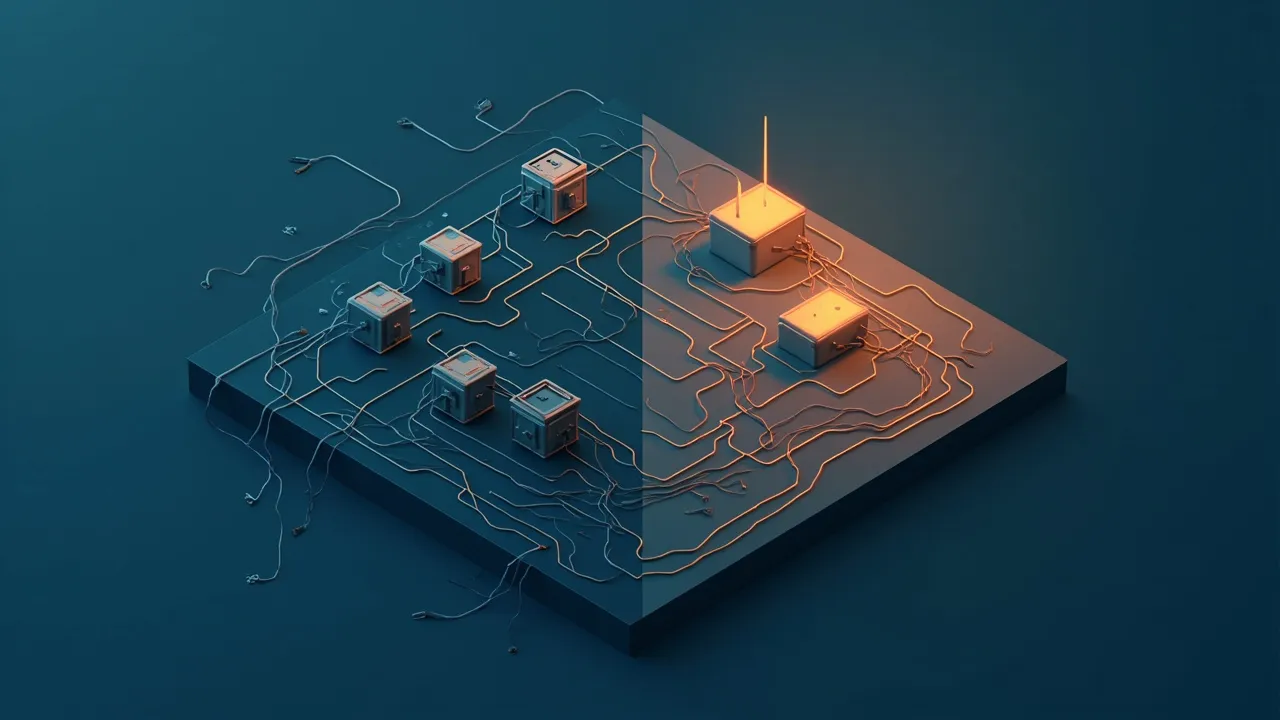
Most businesses do not decide to build custom software. They arrive at it, usually after a year of paying for tools that almost work.
The pattern is familiar. You bought a CRM, then a separate quoting tool, then something for scheduling. Each one solved a problem. None of them talk to each other properly, so somebody spends part of every week copying information from one into another, and the job that was supposed to be automated is now a person's afternoon.
The question is not whether custom software is better than off the shelf. It is whether you have reached the point where buying another subscription stops helping.
Off the shelf is usually the right answer
We build custom software for a living and we will still tell you to buy something off the shelf when that is the sensible choice. For most businesses, most of the time, it is.
Accounting is the clearest example. Xero and QuickBooks have thousands of engineer years in them, they handle Making Tax Digital, and they cost less per month than a decent lunch. Nobody should be building their own accounting software.
The same goes for email, payroll, file storage and any process where your business does the same thing as everyone else. If a product already covers most of what you need and the gap is annoying rather than costly, buy the product.
Custom software earns its place in one specific situation: when the way you work is genuinely different from how the available products assume you work, and that difference matters to your customers or your margin.
Six signs you have outgrown your current setup

These are the patterns we see in businesses that end up commissioning a build. Not one of them on its own is decisive, but three or four together usually are.
- Someone has a job that is mostly copying. If a person spends hours each week moving information from one system into another, you are already paying for custom software. You are just paying for it in wages instead of in software, and the version you are paying for makes mistakes when it is tired.
- Your automations break and nobody notices for days. Connector tools are excellent until they are load bearing. When a silent failure on Friday means Monday's numbers are wrong, that glue has become infrastructure without anybody deciding it should be.
- You cannot answer a simple question about your own business. How many jobs did we quote last month and how many converted. If answering that means opening three systems and a spreadsheet, your data is fragmented, and the reason decisions feel like guesswork is that they are.
- Two people run the same process differently. Because no single tool fits everybody, teams invent their own workarounds. Now there are two versions of the truth and somebody reconciles them by hand.
- The subscription bill grows faster than the business. Per seat pricing means hiring gets more expensive twice. Add up everything you pay monthly across every tool, multiply by thirty six, and compare it against a one off build. The number surprises people.
- You have stopped asking for things. This is the quietest sign and the most telling. When the team no longer suggests improvements because the answer is always that the software cannot do it, the software has started shaping the business rather than serving it.
What custom actually means

Custom does not mean rebuilding everything you currently use. In most projects we do the opposite.
The usual shape is a system that handles the part of your business that is genuinely yours, connected to the off the shelf products that are doing a fine job already. Your accounting stays in Xero. Your custom system handles the workflow nobody sells properly, and it talks to Xero so nobody retypes an invoice.
That is a much smaller project than replacing your whole stack, and it targets the thing actually costing you time.
We have written a fuller explanation of how a custom build works in our practical guide to custom software development if you want the detail on process and stages.
What it costs, honestly
The number people should compare is not the build price against zero. It is the build price against what the current situation already costs.
That existing cost has three parts, and most businesses only ever count the first:
- The subscriptions. Easy to total and usually higher than people expect once every tool is listed.
- The hours. Someone copying data for six hours a week is roughly a month of salary a year, spent on work that produces nothing.
- The things that go wrong. The quote that never got sent, the follow up that got missed, the customer who went elsewhere because nobody called back. Harder to measure and often the biggest of the three.
Set against that, a custom build is a one off cost plus ongoing maintenance, typically a modest percentage of the build each year. It stops scaling with your headcount, which is the structural difference from a subscription.
We will not put a price range in an article, because a quoting tool for a two person business and a scheduling platform for fifty staff are not the same project and pretending otherwise helps nobody. What we will do is tell you early if we think the build costs more than the problem is worth.
Three things to settle before you sign anything
These matter more than the day rate and they are much harder to fix afterwards.
- Who owns the code. It should be you, in writing, from the start. If a supplier is vague about this, that is your answer.
- Who can maintain it. Ask what happens if you want to move to a different developer in two years. Software built on unusual foundations by one person is a liability regardless of how well it works today.
- What happens after launch. Software is not finished when it ships. Establish what support looks like, what it costs, and how changes get made, before you start rather than after.
How to start small
The most common mistake is trying to build everything at once, because that is how you end up with a long project, a large bill and nothing working until the end.
The better approach is to take the single worst part of your week, the specific thing that wastes the most time or loses the most money, and build only that. Get it working, get people using it, then decide what is next with real information instead of assumptions.
Businesses that build this way tend to end up with systems they actually use. Businesses that specify everything up front tend to end up with a long list of features nobody asked for and one part that finally fixed the original problem.
Talk to us before you commit to anything
At Rinaztec we build custom software, CRM systems, business automations and AI agents for UK businesses. We start with the operational problem, not with a technology recommendation.
In practice that means the first conversation is about how your business actually runs: what happens when an enquiry comes in, where things get stuck, what people work around. Often that points at something much smaller than a full system, and occasionally it points at a product you could buy tomorrow for a fraction of the cost.
We would rather tell you that than build you something you did not need. It is a shorter conversation and a better outcome, and the businesses we say no to are usually the ones who come back later with the right project.
- Email: riaz@rinaztec.com
- Get in touch: rinaztec.com/contact
- What we do: rinaztec.com/services
Tell us what is slowing your business down and we will tell you honestly whether custom software is the answer or whether something simpler will do.