
An AI receptionist is software that answers your phone in a natural voice, works out what the caller wants, and either deals with it or passes it to a person. In UK businesses it reliably covers calls that ring out, out of hours enquiries, appointment booking and basic qualification. It is not a replacement for judgement, and it should not be taking your difficult calls.
That is the honest summary. The rest of this article explains where the line sits, and what UK law requires before you switch one on.
At a glance: an AI receptionist earns its place on predictable, repetitive calls. It fails on complaints, distress and negotiation. Before going live you need a lawful basis for recording, a caller announcement and a retention period, all of which are settled in an afternoon.
What an AI receptionist actually is
Three terms get used interchangeably, and they mean different things.
A virtual receptionist is a human being, usually in a call centre, answering your phone under your business name. An AI receptionist is software doing that job. An auto attendant is the old press one for sales, press two for accounts menu, which routes calls but understands nothing.
The change worth paying attention to is that AI receptionists now hold a conversation rather than parse a menu. For example, a caller can say "I need someone out to look at a leak, ideally Thursday" and the system extracts the intent, the job type and the preferred day without the caller pressing a button.
The calls it handles well
Four categories, and they share one trait: the outcome is predictable and the information needed is finite.
Answering when nobody can. The clearest win. A plumber under a sink, a joiner running a saw and a salon mid appointment have the same problem, which is that the phone rings when their hands are full. An AI receptionist answers on the first ring every time.
Out of hours and weekends. Enquiries do not respect opening times. A caller at nine on a Sunday evening either reaches something useful or rings the next firm on the list.
Qualification. Capturing name, number, postcode, job type and rough timescale, then writing it into your system in a consistent format. This quietly saves the most administrative time. It removes the transcription step, which is where details usually get lost.
Booking into a live diary. Some diaries follow rules software can read, such as slot length, travel time between jobs and which staff member can do which work. Where that is true, an AI receptionist can book directly and skip the callback loop.
The calls it should never take
This is the section most vendors skip, and it decides whether the thing works in your business.
Complaints. A caller who is already annoyed does not want an efficient system. They want a person who can apologise and take ownership. Routing a complaint into an automated flow reliably makes it worse.
Anything emotional or vulnerable. Bereavement, a medical worry, financial distress, or a caller who is simply confused. Software cannot read those signals reliably, and the cost of getting it wrong is not a lost booking, it is harm to a person.
Judgement calls and negotiation. Whether to squeeze in an emergency job, whether to discount, whether this customer is worth an exception. These need context that lives in someone's head.
High value or unusual enquiries. The call that could become your biggest job of the year deserves a human on the first attempt.
The practical test we apply when scoping these systems is whether the correct answer depends on who is asking rather than what they are asking. If it depends on who, route it to a person. That single rule removes most failure cases before a line of configuration is written. It is the first question we ask when designing a voice system for a client.
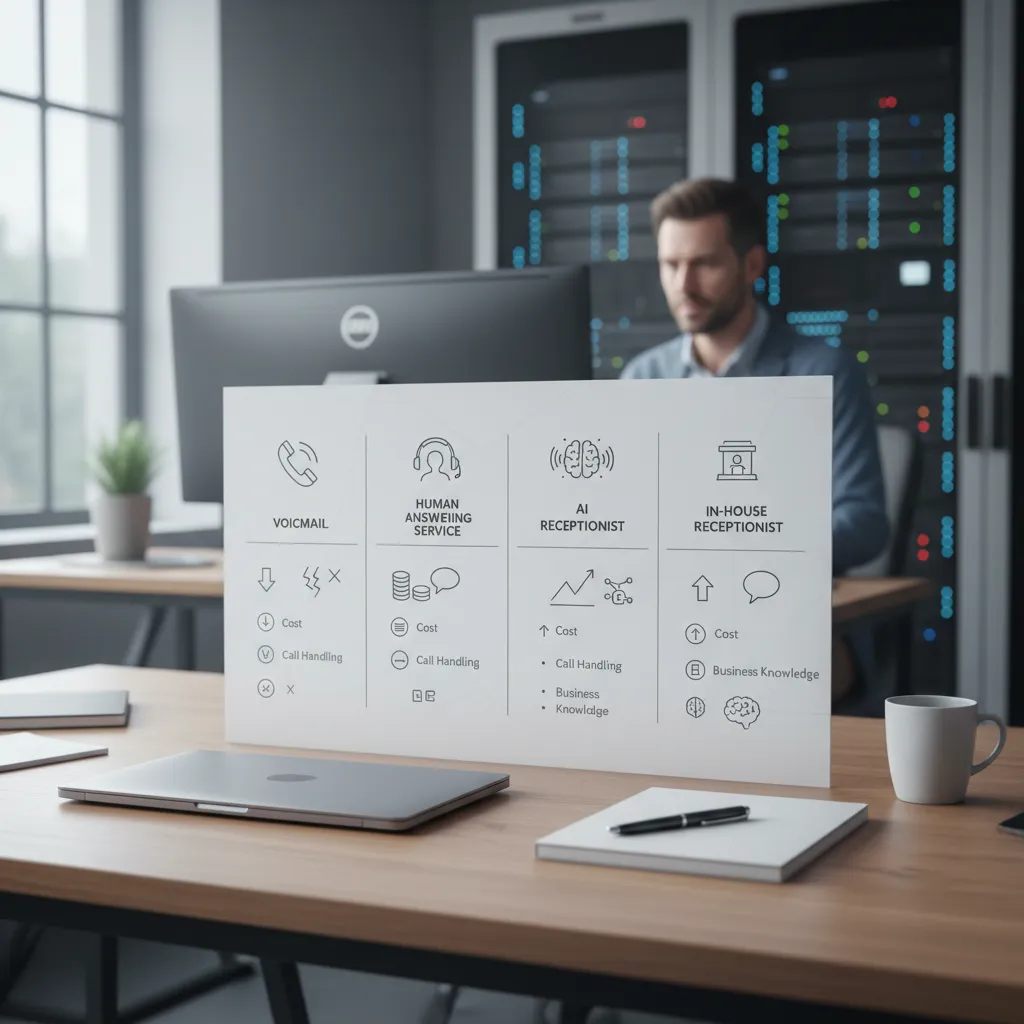
How the options compare
| Option | Answers every call | Cost pattern | Handles complex calls | Knows your business |
|---|---|---|---|---|
| Voicemail | Yes, badly | None | No | No |
| Human answering service | Usually | Per call or per minute | Partly | Only from a script |
| AI receptionist | Yes | Flat, does not scale with volume | No, escalates instead | Yes, if integrated |
| In house receptionist | During hours only | Salary | Yes | Yes |
The interesting column is the last one. A human answering service works from a script and does not know that a particular customer is mid job, or that a postcode falls outside your area. A well integrated AI receptionist reads your actual system and does.
What UK law requires before you switch one on
An AI receptionist records and processes calls, which puts you inside UK data protection law. The rules are not onerous, but they are not optional either.
You need a lawful basis. Every recording needs a documented lawful basis under the Data Protection Act 2018, which brings UK GDPR into domestic law. Most businesses rely on legitimate interests rather than consent, because consent can be withdrawn at any moment. The ICO guide to lawful basis sets out the six options and what each demands.
You may not always need explicit consent to record. The Telecommunications (Lawful Business Practice) (Interception of Communications) Regulations 2000 permit recording without consent for defined business purposes. Those purposes include evidencing a transaction, meeting regulatory obligations, training staff and preventing crime. Those regulations govern interception only. They do not remove your separate duty to hold a lawful basis for processing the resulting data.
You must tell callers. An announcement at the start of the call is the standard way to meet the transparency duty, and it costs you nothing.
Retention has a limit. Recordings cannot be kept indefinitely on the basis that they might be useful one day. Decide the period before you go live, and make the system enforce it.
Serving EU customers adds a disclosure duty. If you take calls from the EU, the EU AI Act applies alongside UK law. Its transparency rules require that people are told when they are interacting with an AI system rather than a person. The European Commission maintains an overview of the regulatory framework for AI. In practice this is one extra line in the greeting.
Staff have separate rights. Your team are data subjects too. The ICO guidance on monitoring workers covers what you must tell staff when their calls are recorded.
None of this stops you using an AI receptionist. It means the announcement, the retention period and the lawful basis should be settled before the first call rather than after the first complaint.
Integration is what separates useful from annoying
An AI receptionist that cannot see your diary is an expensive answering machine. The questions worth putting to any supplier:

Does it read live availability, or a copy that goes stale? Can it write the enquiry into the system you already use, or does someone re key it afterwards? What happens when it does not understand, and how fast does that reach a human? Can it recognise an existing customer from their number? Does it keep the number you already advertise? That last one matters, because changing it means reprinting vans and signage.
What setup realistically involves
Expect the work to sit in three places, and expect most of it to be yours rather than the supplier's.
The first is deciding what the system may and may not do, which is the section above turned into rules. The second is connecting it to your diary and your customer records. The third is the escalation path, meaning who it rings, in what order, and what happens when nobody picks up.
The parts businesses underestimate are the escalation rules and the phone number. Voice quality, which is what everyone worries about, is rarely the problem now.
Frequently asked questions
Is an AI receptionist legal in the UK?
Yes. Recording and processing calls is lawful when you hold a documented lawful basis under UK GDPR, tell callers the call is recorded, and keep recordings only as long as you need them.
Do I need to tell callers they are speaking to AI?
It depends where they are calling from. No blanket UK statute requires it, but if you take calls from the EU the EU AI Act transparency rules do. Disclose either way. Callers work it out, and discovering it after the fact damages trust more than being told at the start.
Can an AI receptionist book appointments?
Yes, where availability follows rules the system can read, such as slot length, travel time and staff skills. Booking quality depends almost entirely on the diary integration rather than the voice.
What happens if it cannot answer the question?
A well configured system escalates to a person immediately rather than improvising. Escalation behaviour is the single most important thing to test before going live.
Is an AI receptionist better than a human answering service?
Not universally. AI wins on cost at volume, consistency and integration with your systems. A human service wins on complaints, emotional calls and anything needing judgement. Many businesses run both, with AI on first line and overflow going to people.
How long does it take to set up?
The technical connection is usually quick. The time goes into defining what it may do, connecting your diary and customer records, and testing the escalation path properly.
Where this leaves you
An AI receptionist is a good answer to a narrow, common and expensive problem, which is the call nobody could pick up. It is a poor answer to calls that need judgement. The businesses that get the most from one are those that draw that line deliberately.
If the phone is a problem in your business, the first question is not which product to buy. It is which calls you would genuinely be happy for software to answer.
Rinaztec builds custom software and AI voice systems for UK businesses, including receptionists that connect to the systems a business already runs. You can see the rest of our work or read about what we build. If you want to talk through which of your calls could be handled automatically and which should not be, get in touch for a no obligation conversation about your workflow.