
An MVP (minimum viable product) is the smallest version of your product that solves one core problem well enough for real customers to use it, and ideally pay for it. Its job is not to impress anyone. Its job is to show you, quickly and cheaply, whether people actually want what you plan to build.
The idea comes from the Lean Startup method, where Eric Ries described the MVP as the version of a product that gives you the most learning about customers for the least effort. This guide explains what that means in practice and how to build one without spending your budget on the wrong things.
At a glance: pick one user, one problem and one core feature. Decide before you build what result would count as success. Launch to real people as early as you can, measure what they do, and only then decide what to build next.
MVP vs prototype vs full product
These three words get mixed up all the time, and the mix-up is expensive. A prototype helps you test an idea. An MVP helps you test a business. A full product helps you grow one.
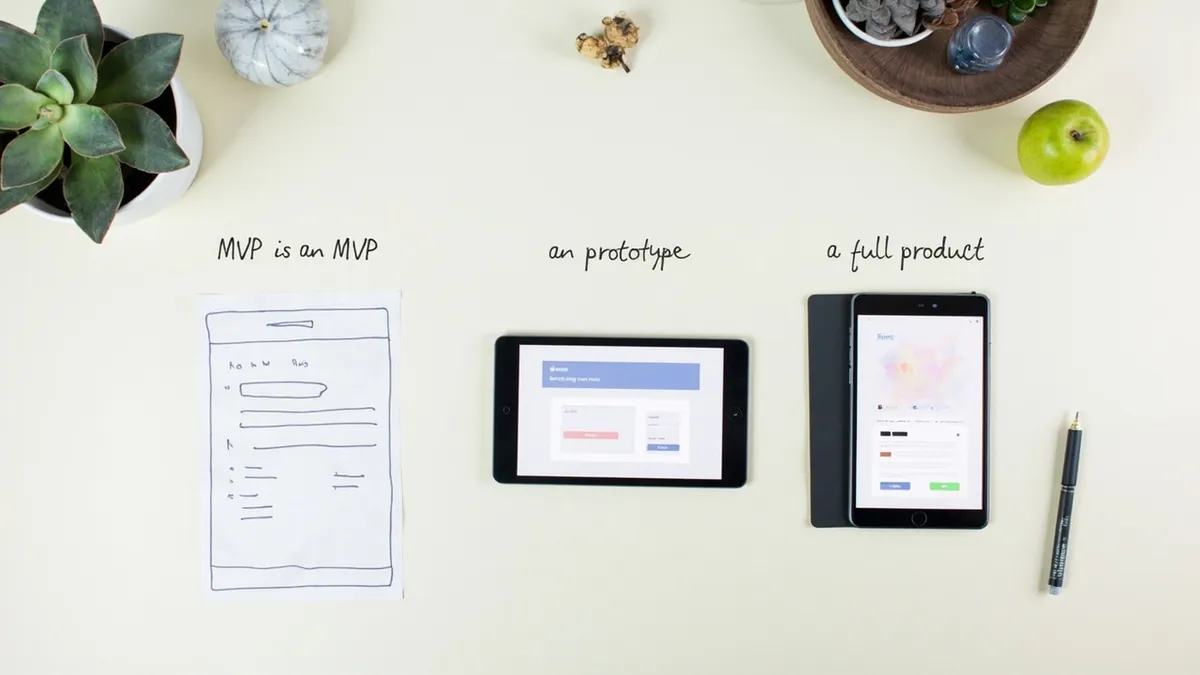
| Prototype | MVP | Full product | |
|---|---|---|---|
| Purpose | Test whether an idea or design makes sense | Test whether real users will use and pay for it | Serve and grow a proven market |
| Who uses it | A handful of people in test sessions | Real early customers | Your whole market |
| Does it work? | Often clickable screens only, no real data | Yes, for the core job, with real accounts and data | Yes, with many features, polish and scale |
| What you learn | Is this easy to understand? | Do people want this enough to come back or pay? | How do we grow and keep customers? |
The UK government uses a similar ladder for its own digital services. Its Service Manual describes a discovery phase to understand the problem, an alpha phase to build and test prototypes, and a beta phase where a working service goes out to real users in private and then public. It is a useful model even for a small business.
One more point: an MVP does not always need code. The Agile Alliance notes that an MVP can be as simple as a landing page, or a service that looks automated but is run by hand behind the scenes. If you can test demand that way first, do it.
How to pick the one core feature
A common way to waste an MVP budget is building features nobody needs yet. To find the one that matters, answer these questions in writing:

- Who is the first user? Not "small businesses". Something like "independent dental practices with two to five chairs".
- What painful job do they do today? Describe how they do it now, with spreadsheets, phone calls or another tool.
- What is the one action that removes that pain? That action is your core feature. Everything else supports it.
- What would make them pay? If you cannot answer this, talk to more potential customers before building anything.
Then list every other feature you have in mind and sort each one into "needed to use the core feature" or "nice later". Sign-up, the core feature and a way to take payment usually make the first list. Admin dashboards, multiple user roles, integrations, dark mode and a mobile app often do not.
What "done" looks like for an MVP
An MVP is done when it can answer your key question, not when it feels finished. Before you build, agree what "done" means. A good definition covers:
- The core journey works end to end: a new user can sign up, do the main job and, if relevant, pay.
- It is safe to use: logins are secure, data is backed up and payments go through a trusted provider. Minimum does not mean careless.
- You can measure it: you can see who signed up, who used the core feature and who came back.
- You have a success test: for example, a target number of paying users or repeat uses within a set number of weeks, chosen by you before launch.
- Real people are using it: a named group of early users, not only friends and family.
The Lean Startup calls this the build, measure, learn loop. You build the MVP, measure what users actually do, and learn whether to keep going, change direction or stop. That decision is the real output of an MVP.
The mistakes that waste MVP budgets
Too many features
Every extra feature adds design, build and testing time, and makes it harder to tell what users actually value. If a feature is not needed for the core journey, park it. You can add it in weeks once you know people want the product.
No launch plan
Many founders spend months building and then have no one to show it to. Start collecting early users before you build: a waiting list, conversations with potential customers, a list of businesses you know. Decide who will get access on day one.
Building a prototype and calling it an MVP
Clickable screens are great for testing design, but they cannot tell you whether people will pay. If nobody can actually use it and pay for it, you have not tested the business yet.
Polishing before learning
Custom animations, perfect branding and edge case handling can wait. Clean, simple and reliable is enough for early users. Spend the polish budget after you know what to polish.
Choosing a throwaway build
The opposite mistake is building something so rough it has to be thrown away the moment it works. Use a sensible, common tech stack and make sure you own the code and accounts, so a successful MVP can grow into the full product. For a wider view of budgets, see our app development cost guide.
When you do not need to build an MVP yet
Sometimes the honest answer is: do not build yet. If you have not spoken to at least a handful of potential customers, start there. If an off-the-shelf tool, a form and a spreadsheet can deliver the service by hand for your first customers, run it that way and learn. Build software when manual work is the thing holding you back, not before.
How Rinaztec can help
We build MVPs for founders and startups: a real, working product that users can sign up to and pay for, with product scoping, custom design, user accounts, Stripe payments, launch and 30 days of post-launch support. We help you cut scope to what proves the idea, give you a fixed quote before we start and you own the full source code. See our MVP development service: from $8,000, launched in 4 to 6 weeks, with a working preview link in week one.
Got an idea you want to test with real users? Book a free 30-minute call and we will help you find your core feature.