
Choosing between Odoo ERP and a custom ERP comes down to how standard your processes are. If your business sells, buys, stocks and invoices in fairly normal ways, Odoo is often the better and cheaper choice. A custom ERP (software built only for your business) earns its cost when your operations are unusual, or when you would otherwise spend heavily bending Odoo to fit.
This guide gives an honest comparison for businesses in Saudi Arabia and the UAE, including when Odoo clearly wins and when a hybrid of both makes more sense.
At a glance: start with Odoo if your processes are standard, your budget is modest and you want to go live quickly. Consider custom software when your workflows are your competitive edge, when customisation keeps growing, or when you need full control of the code. Many businesses land in the middle: Odoo for the standard parts, with a few custom modules for what makes them different.
What Odoo is, in plain words
Odoo is a suite of business apps (accounting, sales, inventory, purchasing, manufacturing, HR and more) that share one database. It comes in two editions. Community is open source under the LGPL version 3 licence, which means you can use and modify it freely. Enterprise is sold as a subscription under Odoo's own licence and adds more apps and features.
Odoo's pricing page lists a free plan for one app with unlimited users, and paid per-user plans for all apps. Features such as Odoo Studio (its no-code customisation tool), multi-company and the external API (the connection other software uses to talk to Odoo) sit in the higher plan. Prices change and vary by region, so check the Odoo pricing page for current figures.
Where Odoo is the right answer
Odoo is a strong choice in many Gulf businesses, and it would be poor advice to pretend otherwise. It usually fits best when:
- Your processes look like most businesses in your sector: quote, order, deliver, invoice, get paid.
- You want to go live in weeks, not build something from scratch.
- Your budget is modest and a per-user subscription is easier to approve than a build project.
- You are happy to adjust some of your habits to match how the software works.
Local compliance is covered too. Odoo's documentation describes a Saudi Arabia localisation with a ZATCA e-invoicing module, and a UAE localisation with a chart of accounts, VAT tax groups and VAT returns in the Federal Tax Authority format. For Saudi invoices, the docs explain how to add Arabic as a second language, since Saudi VAT rules require tax invoices in Arabic. Check which edition and plan includes the modules you need before you commit.
Where Odoo starts to strain
Odoo is flexible, but flexibility has a cost. The problems usually come from how it is set up, not from Odoo itself.
Heavy customisation. Every business has a few processes that do not fit. A small amount of custom work is normal. When the list of changes keeps growing, you can end up paying a subscription and a development bill, and still working around gaps.
Upgrades. Odoo's own upgrade documentation says each major version is supported for three years, and that a database with custom modules cannot be upgraded until those modules are updated for the new version. The more custom code you add, the bigger each upgrade project becomes. Budget for this from day one.
Arabic reports and e-invoicing done badly. The tools exist, but a rushed setup can leave invoice layouts, Arabic labels or the ZATCA connection half finished. In Saudi Arabia, e-invoices must meet ZATCA's rules, so test real invoices end to end before go-live. UAE businesses face their own e-invoicing changes; our UAE e-invoicing guide explains them.
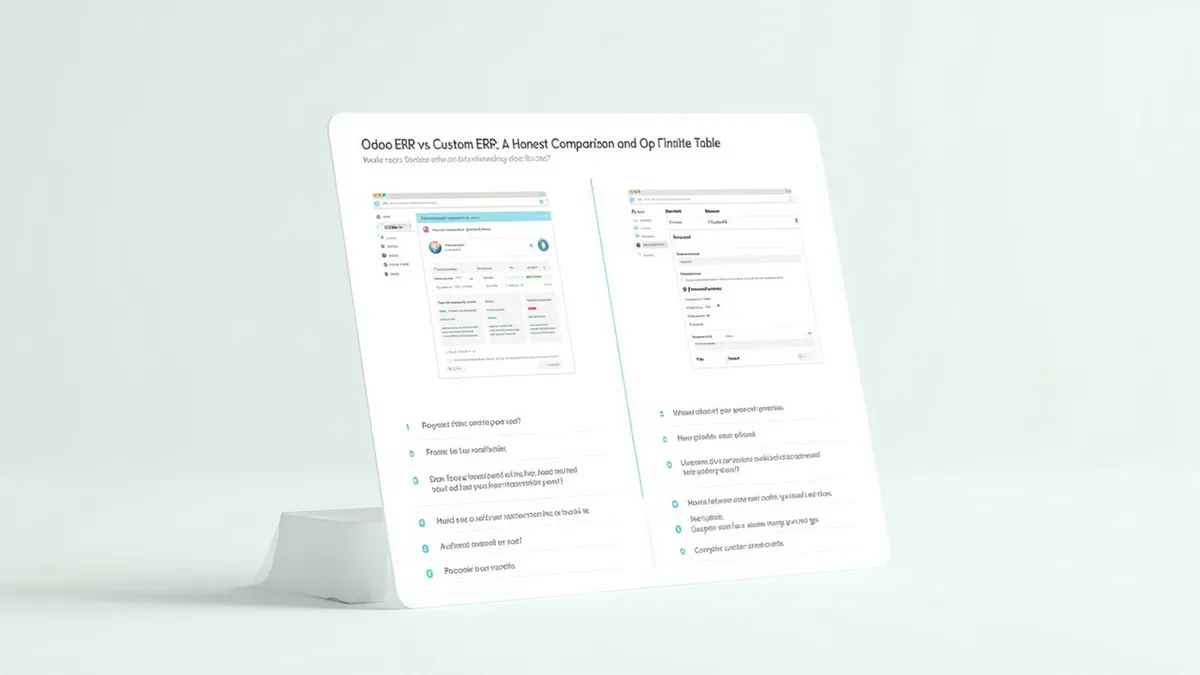
Odoo vs custom ERP: a decision table
| Question | Leans towards Odoo | Leans towards custom |
|---|---|---|
| How standard are your processes? | Mostly standard | Unusual, and they give you an edge |
| How fast do you need to go live? | Weeks, with little building | Can phase it over months |
| How much customisation would you need? | A few settings and small tweaks | Many custom screens and rules |
| How do you want to pay? | Ongoing per-user subscription | Up-front build per phase, plus hosting and support |
| Who controls the roadmap? | The vendor sets the release cycle | You decide what changes and when |
| How many users? | Any size, priced per user | No per-user licence fee |
If most of your answers sit in the Odoo column, choose Odoo and spend your effort on a good implementation. If most sit on the right, a custom build is worth pricing.
The hybrid option: Odoo plus custom modules
You do not have to choose one or the other. A common middle route is to run Odoo for accounting, invoicing and standard stock, and build one or two custom pieces for the work that is truly yours: a production tracker, a job-costing tool or a customer portal.
Those pieces can live inside Odoo as custom modules, or sit outside it as separate software that talks to Odoo through its API. Keeping them outside makes Odoo upgrades simpler, because your core system stays close to standard. Keeping them inside gives one screen for users. Either way, write down who maintains each part.
Questions to ask before you decide
- Which three processes cost us the most time or money today?
- Can Odoo handle them with settings alone, or only with custom code?
- What will the next major upgrade cost, including our custom modules?
- Have we tested real Arabic invoices and the e-invoicing connection, not just a demo?
- Who owns the code and the data if we change supplier?
Whatever you choose, the rollout matters as much as the software. Our ERP implementation guide covers scope, data and go-live. This article is general information, not legal or tax advice.
How Rinaztec can help
Rinaztec builds custom ERP software in phases, starting with the module that hurts most, such as inventory, orders, production or job tracking, with integrations to accounting, e-commerce and shipping tools. You own the full source code. Custom ERP development starts from $15,000, with each phase typically taking 6 to 10 weeks.
Not sure whether Odoo or a custom build fits your business? Book a free 30-minute call and we will give you an honest view.